A BMW rally car is a BMW vehicle that has been specially modified for rally racing. It features upgrades to the engine, suspension, brakes, tires, and safety systems to handle rough roads, gravel, mud, and snow. Unlike a standard road car, a rally car is built to deliver speed, durability, and control in challenging conditions.
BMW has a long history in motorsport, but many people only know the brand for its luxury cars and sports sedans. However, BMW has also produced several memorable rally cars that competed in national and international events. These cars helped build BMW’s reputation for performance and engineering excellence.
This guide explores the history of BMW rally cars, highlights the most iconic models, and explains their key performance features. It also covers notable rally achievements, famous drivers, build costs, maintenance, and buying tips. By the end, you will have a clear understanding of BMW’s rally racing legacy.
BMW Rally Car Origins
BMW entered rally racing to prove the strength and reliability of its performance cars. During the 1960s and 1970s, the company began adapting production models for competitive rally events. These early efforts helped BMW gain valuable experience in motorsport.
The first BMW rally cars focused on lightweight construction, balanced handling, and dependable engines. Instead of building purpose-made rally machines, BMW modified road cars to perform on gravel, dirt, snow, and tarmac stages. As a result, these cars became known for their agility and durability.
Over time, BMW expanded its rally presence through improved technology and stronger performance models. Cars such as the BMW 2002 and later the E30 M3 earned recognition in rally competitions around the world. Although BMW later shifted its focus toward other forms of motorsport, its rally heritage remains an important part of the brand’s performance history.
Early Motorsport Development
BMW began competing in motorsport long before it became known for luxury performance cars. In the 1930s, the company entered hill climbs, endurance races, and touring car events. These competitions helped BMW improve vehicle performance and engineering.
After World War II, BMW returned to racing with renewed focus. During the 1960s, the company developed lightweight and powerful cars that performed well in different motorsport disciplines. Models like the BMW 1800 and BMW 2002 became popular because they combined speed with reliable handling.
The knowledge gained from these early racing programs also supported BMW’s rally efforts. Engineers improved engines, suspension systems, and chassis design through competition. These developments created a strong foundation for the BMW rally cars that followed.
Entry into International Rallying
BMW entered international rallying as rally racing became more popular across Europe. The company began entering modified production cars in well-known events. These competitions allowed BMW to test its engineering in demanding conditions.
During the 1960s and 1970s, models such as the BMW 2002 competed in rallies on gravel, snow, and asphalt. Skilled drivers and reliable cars helped BMW earn strong results in several national and international events. These performances increased the brand’s reputation in motorsport.
As rally technology advanced, BMW continued to improve its cars with better suspension, stronger engines, and enhanced safety features. Although the company later focused more on touring car racing, its international rally efforts remain an important part of BMW’s motorsport history.
Iconic BMW Rally Car Models
BMW has produced several rally cars that left a lasting mark on motorsport. Most of these vehicles started as production models before engineers modified them for competition. They combined strong performance with balanced handling on different rally surfaces.
Some BMW rally cars became famous because of their success in national and international events. Others earned recognition for their reliability and driving dynamics. These models helped strengthen BMW’s reputation as a performance-focused brand.
Each BMW rally car reflects a different stage of the company’s motorsport journey. From classic rear-wheel-drive machines to modern rally-inspired vehicles, these models showcase BMW’s engineering skills and racing heritage. The following sections highlight the most notable examples.
BMW 2002 Ti
The BMW 2002 Ti was one of the brand’s earliest performance cars to gain success in rally racing. Introduced in the late 1960s, it featured a lightweight body and a responsive four-cylinder engine. These qualities made it well suited for demanding rally stages.
Rally teams upgraded the BMW 2002 Ti with stronger suspension, improved brakes, and safety equipment. The car handled gravel, snow, and paved roads with confidence. Its balanced chassis also gave drivers better control through tight corners.
The BMW 2002 Ti helped establish BMW’s reputation in rally motorsport. It earned strong results in several European rally events and proved that BMW could compete against well-known rivals. Today, the 2002 Ti remains one of the most respected classic BMW rally cars.
BMW E30 M3
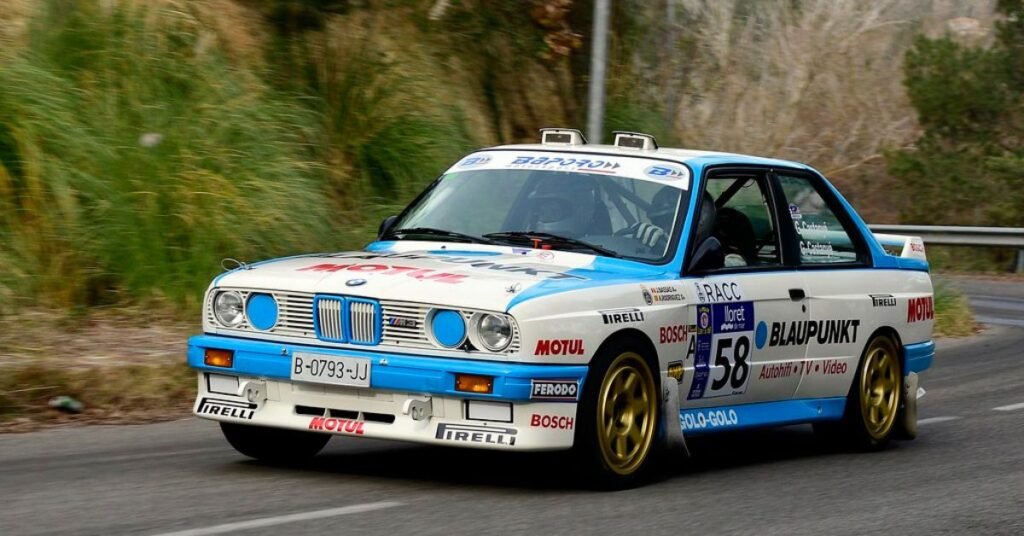
The BMW E30 M3 is one of the most famous performance cars ever built by BMW. Although it became a legend in touring car racing, it also competed successfully in rally events. Its powerful engine, balanced chassis, and rear-wheel-drive layout made it a strong competitor.
Rally teams modified the E30 M3 with reinforced suspension, protective safety equipment, and rally tires. These upgrades improved its performance on gravel, snow, and tarmac stages. Skilled drivers appreciated its precise steering and predictable handling in difficult conditions.
The BMW E30 M3 achieved success in several national and international rallies during the late 1980s and early 1990s. Its rally achievements added to its already impressive motorsport legacy. Today, the E30 M3 remains one of the most iconic BMW rally cars and a favorite among collectors and enthusiasts.
Modern MINI Rally Cars
Modern MINI rally cars continue BMW’s rally heritage because BMW has owned the MINI brand since 1994. These cars were designed for international rally competition and combine compact size with advanced engineering. Their agile handling makes them well-suited for challenging rally stages.
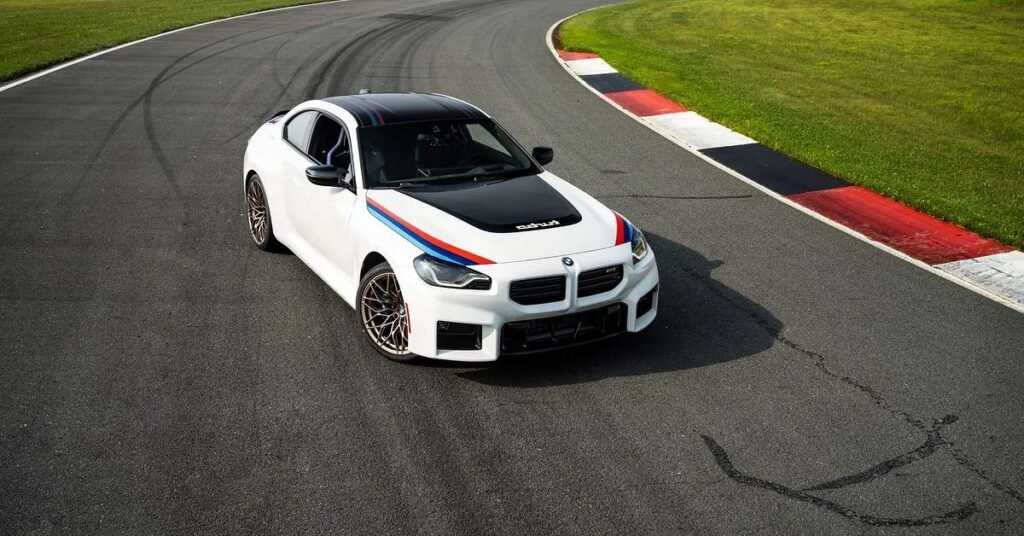
One of the best-known models is the MINI John Cooper Works Rally. It competed in major events such as the Dakar Rally and proved its durability on rough terrain. The car features a powerful engine, reinforced suspension, four-wheel drive, and advanced safety systems.
Modern MINI rally cars have earned victories and podium finishes in international competitions. They show how BMW continues to support rally motorsport through the MINI brand. Today, these vehicles represent the latest chapter in BMW’s rally racing legacy.
BMW Rally Car Specifications
BMW rally cars use different specifications depending on the model and competition class. However, they all focus on performance, durability, and driver control. Compared with standard road cars, they feature stronger components and race-ready equipment.
Most BMW rally cars have powerful petrol engines, upgraded transmissions, reinforced suspension, and high-performance braking systems. Many also include limited-slip differentials, roll cages, racing seats, and multi-point harnesses for better safety. Lightweight materials help reduce weight and improve handling.
The exact specifications vary between classic models like the BMW 2002 Ti and newer rally cars based on the MINI platform. Even so, every BMW rally car is designed to perform on gravel, dirt, snow, and asphalt. These features allow the cars to handle the demanding conditions of rally racing.
Key Features of a BMW Rally Car
A BMW rally car is built to perform in tough racing conditions. It must stay fast, stable, and reliable on gravel, mud, snow, and asphalt. Therefore, it includes many upgrades that are not found on standard road cars.
These rally cars use stronger suspension, performance brakes, and specialized rally tires for better grip. They also feature lightweight parts to improve speed and handling. Inside the cabin, a roll cage, racing seats, and multi-point harnesses protect the driver and co-driver during competition.
Modern BMW rally cars also benefit from advanced engineering and precise tuning. The engine and drivetrain are optimized for quick acceleration and consistent power delivery. As a result, the car remains competitive across different rally stages and changing road conditions.
Engine and Drivetrain
The engine is one of the most important parts of a BMW rally car. It is tuned to deliver strong power and quick throttle response. Rally engines must also remain reliable during long and demanding events.
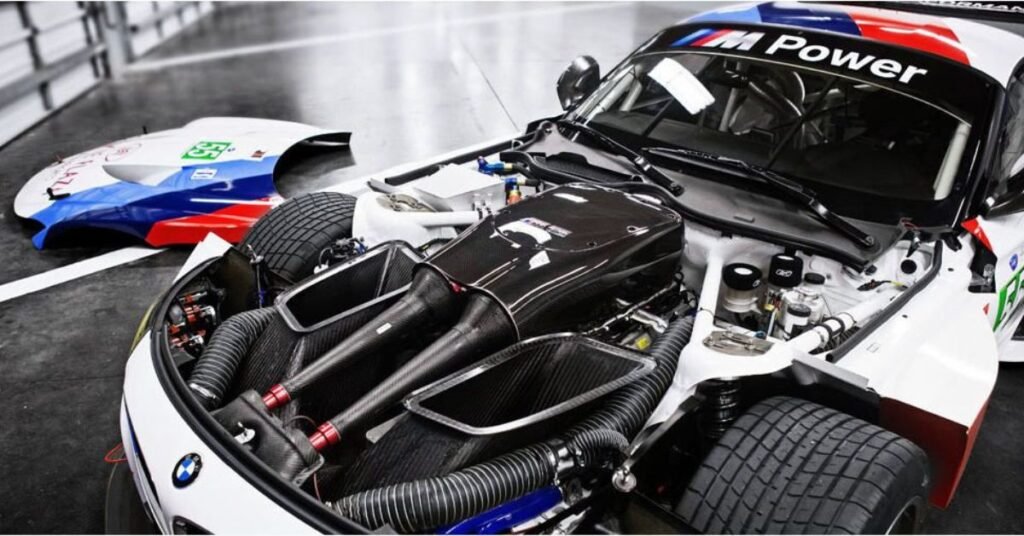
The drivetrain transfers power from the engine to the wheels. Depending on the rally car, it may use rear-wheel drive or four-wheel drive. A limited-slip differential helps improve traction on loose and uneven surfaces.
Rally teams also upgrade the transmission and clutch for faster gear changes and better durability. These improvements help the car accelerate smoothly and maintain control on gravel, mud, snow, and tarmac. As a result, the driver can handle different rally stages with greater confidence.
Suspension and Safety Upgrades
A BMW rally car uses a reinforced suspension system to handle rough roads and hard impacts. The suspension absorbs bumps and keeps the tires in contact with the ground. This setup improves stability and gives the driver better control on every stage.
Rally teams also upgrade the brakes, wheels, and tires to match different surfaces. Strong brakes provide reliable stopping power, while rally tires improve grip on gravel, mud, snow, and asphalt. These upgrades help the car perform well in changing conditions.
Safety is just as important as performance. Every BMW rally car includes a roll cage, racing seats, multi-point harnesses, and a fire suppression system. Drivers also wear helmets and protective gear to reduce the risk of injury during competition.
BMW Rally Car Achievements
BMW rally cars have earned success in many national and international competitions. Over the years, they achieved class wins, podium finishes, and championship titles in different rally events. These results highlighted BMW’s strong engineering and dependable performance.
Classic models such as the BMW 2002 and the BMW E30 M3 played an important role in this success. They performed well on gravel, snow, and tarmac stages against tough competition. Their balanced handling and reliable engines helped drivers achieve consistent results.
BMW’s rally legacy also continues through modern MINI rally cars. Vehicles like the MINI John Cooper Works Rally have achieved success in major off-road events, including the Dakar Rally. Together, these achievements have strengthened BMW’s reputation in global motorsport.
Notable BMW Rally Drivers
Many talented drivers helped build the reputation of BMW rally cars. They competed in national and international events and showed the strength of BMW’s performance models. Their skill and determination played a key role in the brand’s rally success.
One of the best-known names is Achim Warmbold, who drove BMW rally cars during the 1970s. He achieved several strong results in European rally competitions and helped prove that BMW could compete with leading manufacturers. Other drivers also contributed to BMW’s success in regional and international rallies.
In recent years, professional drivers have continued BMW’s rally legacy through the MINI rally program. Competitors such as Joan “Nani” Roma and Stéphane Peterhansel achieved major victories in the MINI John Cooper Works Rally, especially in the Dakar Rally. Their achievements have kept BMW’s rally heritage alive on the world stage.
BMW Rally Car vs. Track Car
A BMW rally car and a BMW track car are built for different types of racing. A rally car competes on gravel, dirt, snow, and asphalt. In contrast, a track car races only on smooth, paved circuits. Therefore, each vehicle uses different parts and tuning to match its environment.
Although both cars focus on performance, their design goals are different. A BMW rally car needs durability, ground clearance, and traction on uneven roads. Meanwhile, a BMW track car prioritizes high-speed cornering, aerodynamics, and maximum grip on a race circuit. The table below highlights the main differences.
| Feature | BMW Rally Car | BMW Track Car |
| Purpose | Rally racing on mixed surfaces | Circuit racing on paved tracks |
| Driving Surface | Gravel, dirt, snow, mud, and asphalt | Smooth racing circuits |
| Suspension | Long travel and reinforced | Lower, stiffer, and track-tuned |
| Ground Clearance | Higher | Lower |
| Drivetrain | Rear-wheel drive or four-wheel drive | Usually rear-wheel drive |
| Tires | Rally tires for different terrains | Slick or semi-slick track tires |
| Brakes | Designed for changing road conditions | Optimized for repeated high-speed braking |
| Aerodynamics | Limited aerodynamic focus | Larger spoilers and splitters for downforce |
| Engine Tuning | Strong low- and mid-range torque | Maximum high-speed performance |
| Safety Equipment | Roll cage, racing seats, harnesses, fire system | Similar safety equipment with circuit-specific setup |
| Vehicle Weight | Lightweight but reinforced for impacts | Lightweight with emphasis on speed |
| Handling | Stable on loose and uneven roads | Precise on smooth corners |
| Maintenance | Frequent checks after rough stages | Frequent servicing after track sessions |
| Best Use | Rally championships and off-road stages | Circuit racing and track days |
How to Build a BMW Rally Car
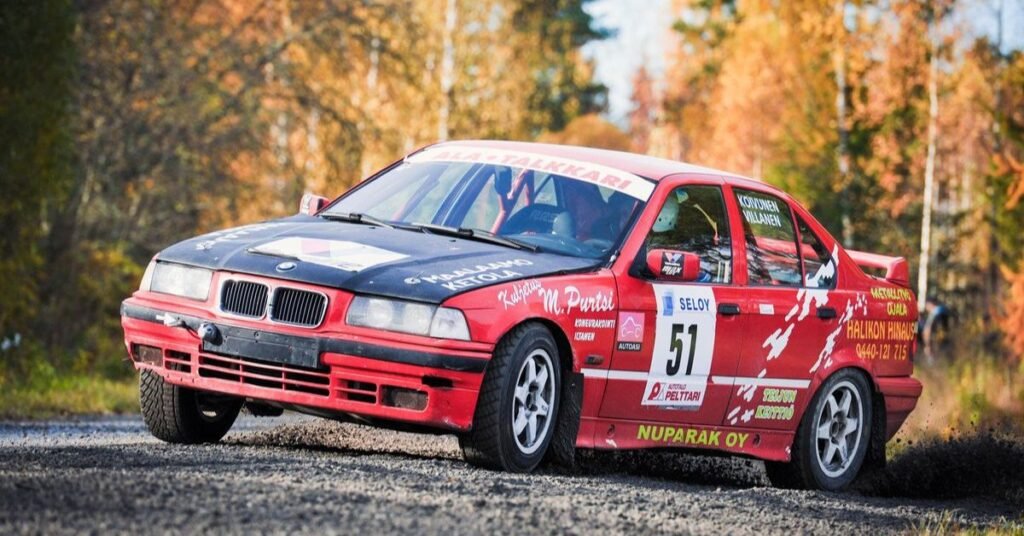
Building a BMW rally car starts with choosing the right vehicle. Popular options include the BMW 2002, E30, E36, and E46 because they have strong aftermarket support. Before making upgrades, check that the car has a solid chassis and no major rust or damage.
Next, install the parts needed for rally racing. Upgrade the suspension, brakes, engine, drivetrain, and cooling system. Add a roll cage, racing seats, multi-point harnesses, and a fire suppression system to improve safety and meet rally regulations.
Finally, test and tune the car before entering any competition. Adjust the suspension and tires to match different rally surfaces. Regular maintenance is also important because rally racing puts heavy stress on every part of the vehicle. A well-built BMW rally car will perform better and remain reliable throughout the season.
BMW Rally Car Maintenance
A BMW rally car requires regular maintenance to stay reliable and competitive. Rally racing puts heavy stress on the engine, suspension, brakes, and drivetrain. Therefore, every major component should be inspected before and after each event.
The engine oil, transmission fluid, and coolant should be checked and replaced at the recommended intervals. Brake pads, brake discs, tires, and suspension parts also need frequent inspection because they wear quickly during rally stages. Replacing worn parts on time helps prevent costly damage.
Cleaning the car after every rally is equally important. Dirt, mud, and small stones can damage mechanical parts if left in place. Regular servicing and careful inspections help a BMW rally car deliver strong performance and remain safe throughout the racing season.
Buying a BMW Rally Car
Buying a BMW rally car requires careful planning. First, decide whether you want a fully built rally car or a project car that you can modify. Your budget, experience, and racing goals will help you make the right choice.
Before you buy, inspect the car carefully. Check the chassis for rust or accident damage, and examine the engine, transmission, suspension, and brakes. If the car has already competed in rallies, ask for its maintenance records and build history.
You should also make sure the car meets the regulations for the rally series you plan to enter. A professional inspection is a smart investment before completing the purchase. Choosing a well-maintained BMW rally car can save money on repairs and provide a better driving experience.
BMW Rally Car Costs
The cost of a BMW rally car depends on the model, condition, and level of preparation. A used project car is usually the most affordable option. In contrast, a fully built rally car with competition-ready upgrades costs much more.
Building a BMW rally car also requires a budget for parts and labor. Common expenses include suspension upgrades, brakes, safety equipment, engine tuning, and rally tires. You should also plan for entry fees, insurance, fuel, transportation, and regular maintenance.
Overall, rally racing is an expensive motorsport. However, careful planning can help you manage your costs. Buying a well-maintained car and keeping up with routine servicing can reduce repair expenses and improve long-term reliability.
Conclusion
BMW rally cars have earned a respected place in motorsport history. From the classic BMW 2002 Ti to the legendary E30 M3 and modern MINI rally cars, these vehicles have shown impressive performance and reliability. Their engineering, handling, and durability continue to attract rally fans around the world.
Whether you want to learn about BMW’s rally heritage or build your own rally car, understanding the right models, features, costs, and maintenance is essential. With proper preparation and regular care, a BMW rally car can deliver an exciting and rewarding motorsport experience.
FAQs
1. What is a BMW rally car?
A BMW rally car is a BMW vehicle that has been modified for rally racing with upgrades to its engine, suspension, safety systems, and drivetrain.
2. Which BMW model is most famous for rally racing?
The BMW E30 M3 is one of the most famous BMW rally cars. The BMW 2002 Ti is also well known for its early rally success.
3. Can I convert a regular BMW into a rally car?
Yes. Many enthusiasts convert models like the E30, E36, and E46 into rally cars by adding performance and safety upgrades.
4. How much does it cost to build a BMW rally car?
The cost varies depending on the model and modifications. A basic build can cost several thousand dollars, while a competition-ready car can cost much more.
5. Are BMW rally cars still used in motorsport today?
Yes. Although BMW no longer has a major factory rally program, rally-prepared BMW models and modern MINI rally cars still compete in various rally events.