A BMW Tesla Supercharger is a Tesla fast-charging station that some BMW electric vehicles can use, depending on the model, charging port, and local network support. These chargers are designed to deliver high-speed DC charging. As a result, BMW EV owners can spend less time waiting and more time driving.
More BMW drivers are looking for faster and more convenient charging options. At the same time, Tesla is opening parts of its Supercharger network to other automakers in many regions. Therefore, many BMW owners want to know whether they can use these chargers, what they need, and how the process works.
This guide explains everything you need to know about the BMW Tesla Supercharger. It covers compatibility, supported BMW models, access requirements, adapters, charging speed, costs, and common issues. In addition, you will find practical tips to help you charge your BMW EV with confidence.
BMW Tesla Supercharger Basics
A BMW Tesla Supercharger refers to using a Tesla Supercharger station to charge a BMW electric vehicle. Tesla Superchargers are high-speed DC fast chargers that are built for quick charging. However, not every BMW EV can use every Tesla Supercharger. Compatibility depends on the charging standard, the vehicle, and the region.
Tesla has expanded access to parts of its Supercharger network in several countries. As a result, some BMW EV owners can now charge at selected Tesla stations. In many cases, drivers may need a compatible charging port or an approved adapter. Therefore, it is important to check whether your BMW supports Tesla Supercharger access before your trip.
Using a BMW Tesla Supercharger can save time during long drives. In addition, the large Supercharger network makes it easier to find fast charging locations. However, charging speed may vary depending on your BMW model, battery level, weather, and the charger itself. Therefore, understanding the basics helps you enjoy a smoother charging experience.
Compatibility
BMW Tesla Supercharger compatibility depends on your BMW model, charging connector, and your location. Not all Tesla Superchargers are open to BMW vehicles. Therefore, you should always check whether the station supports non-Tesla EVs before you arrive.
Most newer BMW electric vehicles use the CCS charging standard in Europe and North America. As a result, many Tesla Supercharger stations with CCS support can charge compatible BMW models. However, older Tesla stations that only have Tesla connectors may not work without special support or approved adapters.
Compatibility also depends on Tesla’s network access in your country. In addition, software updates and charging agreements between BMW and Tesla can affect availability. Therefore, checking your BMW charging app or the Tesla app before your trip can help you avoid charging problems.
Supported BMW Models
Several BMW electric models can use compatible Tesla Superchargers where access is available. These include the BMW i4, BMW i5, BMW i7, BMW iX, and BMW iX1 in supported markets. However, availability depends on the charging network and your region.
Older BMW plug-in hybrid models usually cannot use Tesla Superchargers for DC fast charging. In addition, some early BMW electric vehicles may have limited compatibility because of different charging hardware or local network restrictions. Therefore, it is important to confirm support before planning your trip.
You can check your BMW owner’s manual, the BMW charging app, or the Tesla app to see whether your vehicle is supported. Furthermore, software updates may improve charging compatibility over time. Keeping your BMW updated helps you access the latest charging features.
Access Requirements
Before using a BMW Tesla Supercharger, you must meet a few basic requirements. First, your BMW must be compatible with the selected Tesla Supercharger. In addition, the charging station must allow non-Tesla electric vehicles. Therefore, checking compatibility before your trip is important.
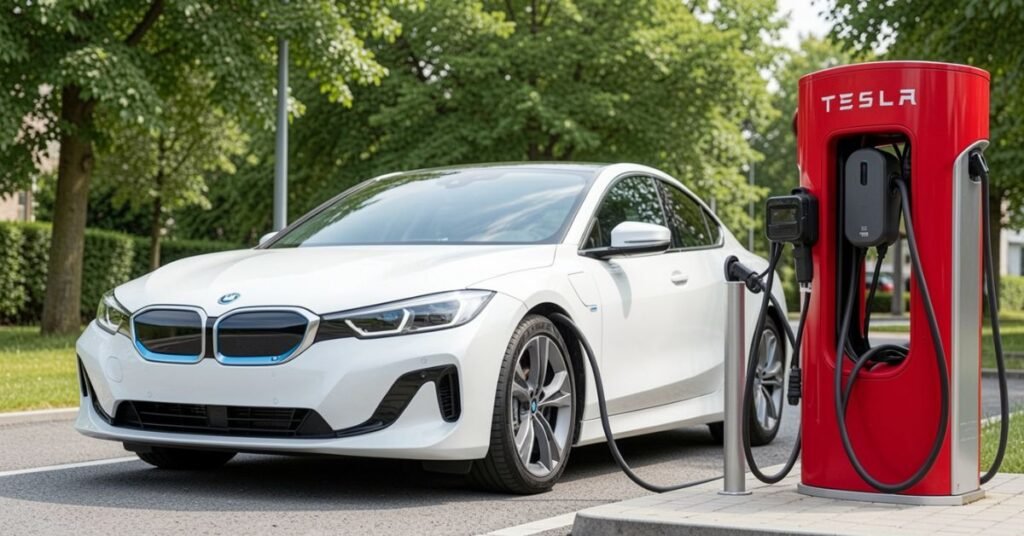
You also need a supported charging connector or an approved adapter, depending on your BMW model and the Supercharger type. Furthermore, many Tesla Supercharger locations require you to use the Tesla app to start and pay for a charging session. Creating an account in advance can save time.
A stable internet connection is also helpful when using the Tesla app. Moreover, make sure your payment method is active before you arrive. By preparing these details early, you can enjoy a smoother and faster charging experience.
Adapter Requirements
Some BMW electric vehicles may need an adapter to use certain Tesla Superchargers. However, the need for an adapter depends on the charging port and the type of Supercharger. Therefore, you should always check your BMW model before buying an adapter.
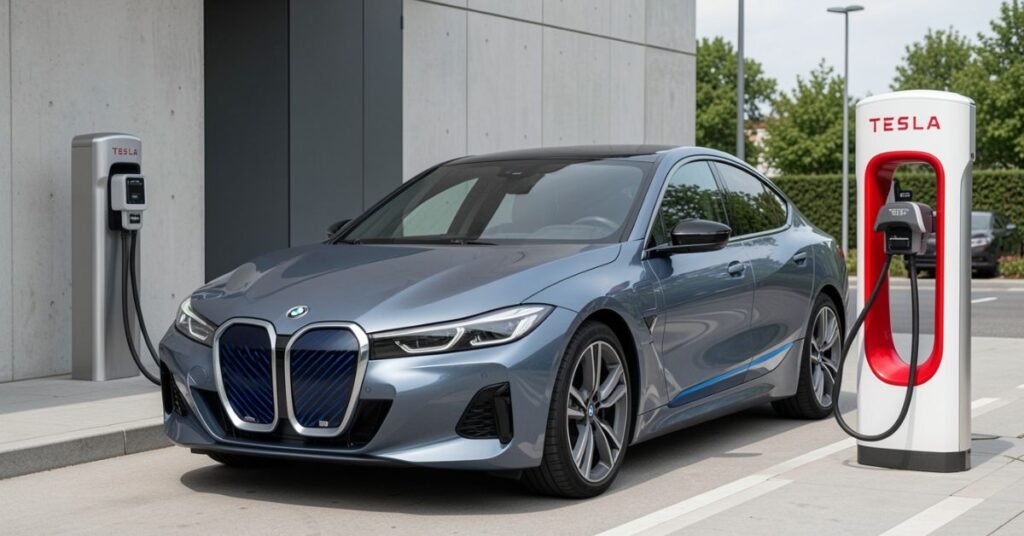
Many Tesla Superchargers in Europe use CCS connectors, so compatible BMW EVs usually do not need an adapter. In contrast, some North American charging setups may require a compatible adapter, depending on the vehicle and the station. Using the correct adapter is important for safe and reliable charging.
Always use an approved, high-quality adapter if one is required. In addition, follow the manufacturer’s instructions during charging. This helps protect your vehicle and ensures the best charging performance.
Charging Steps
Charging your BMW at a Tesla Supercharger is simple if your vehicle is compatible. First, park your BMW in the correct charging space. Then, open the Tesla app and select the Supercharger location. After that, choose the charging stall and start the session. Finally, connect the charging cable to your BMW and wait for charging to begin.
Follow these basic steps for a smooth charging experience:
- Check that the Supercharger supports BMW or other non-Tesla EVs.
- Use an approved adapter if your BMW requires one.
- Plug the charging cable into your vehicle securely.
- Monitor the charging progress in the Tesla app or your BMW display.
- Stop the charging session when you have enough battery.
- Unplug the cable and return it to the charger before leaving.
Charging Speed
BMW charging speed at a Tesla Supercharger depends on your BMW model, battery size, and the type of Supercharger. Most compatible BMW EVs can charge much faster than with a home charger. As a result, long-distance travel becomes more convenient.
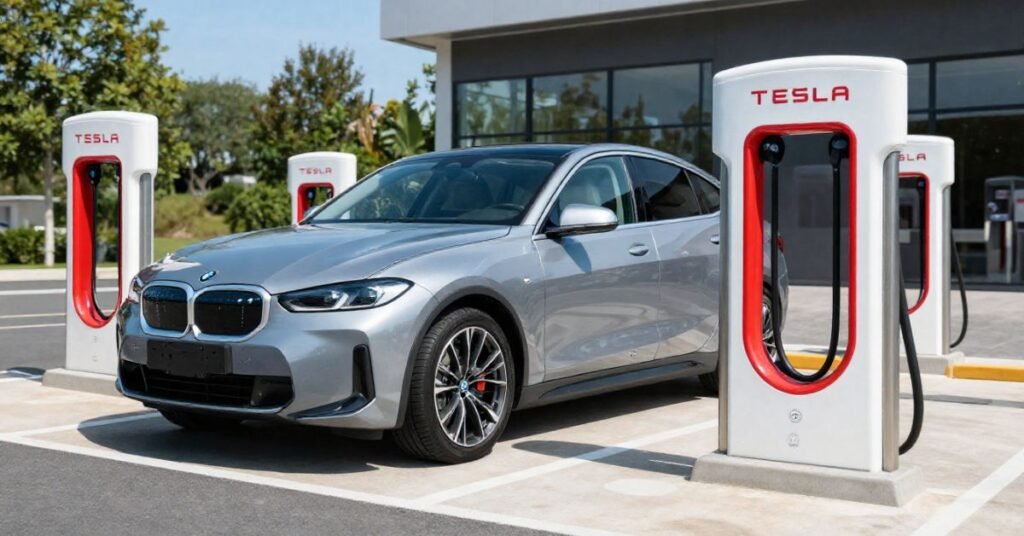
Charging is usually fastest when the battery is at a low state of charge. However, the charging speed slows down as the battery gets closer to full. In addition, outside temperature and battery condition can affect charging performance. Therefore, the actual charging time may vary.
Many BMW electric vehicles can add a significant amount of driving range in a short time when using a compatible fast charger. Furthermore, preconditioning the battery before arriving at the charger can improve charging speed. Following these tips helps you get the best charging performance during every trip.
Charging Costs
The cost of using a BMW Tesla Supercharger depends on your location and the charging station. Tesla sets its own charging prices, and rates may vary by country or region. Therefore, the total cost can be different for each charging session.
Most drivers pay through the Tesla app with a saved payment method. In some areas, charging is billed by the kilowatt-hour (kWh). In other areas, it may be billed by the minute. In addition, idle fees may apply if you leave your BMW connected after charging is complete.
Fast charging is usually more expensive than charging at home. However, it is much quicker and more convenient during long trips. Therefore, many BMW owners use Tesla Superchargers when they need a fast battery recharge away from home.
Common Issues
Some BMW owners may face charging problems at a Tesla Supercharger. In many cases, the charger may not support non-Tesla vehicles. Therefore, it is important to check compatibility before you arrive at the station.
Connection errors can also happen during charging. For example, the charging cable may not be fully connected, or the required adapter may not be installed correctly. In addition, software or app issues can prevent the charging session from starting. Restarting the process often solves these problems.
If charging still does not work, try another Supercharger stall if one is available. Furthermore, check for updates in the BMW and Tesla apps. Keeping your vehicle software up to date and using approved charging equipment can help prevent most charging issues in the future.
Tesla vs CCS Chargers
Tesla Superchargers and CCS chargers both provide DC fast charging for electric vehicles. However, they are not the same. Tesla Superchargers are part of Tesla’s charging network, while many different charging companies offer CCS chargers. Therefore, the best choice depends on your BMW model, location, and charger availability.
CCS chargers are widely supported by BMW electric vehicles. On the other hand, access to Tesla Superchargers depends on network availability and vehicle compatibility. In addition, charging speed, pricing, and payment methods may differ. The table below compares both charging options.
| Feature | Tesla Supercharger | CCS Charger |
| Network | Tesla-operated | Multiple charging providers |
| Main Use | Tesla EVs and supported non-Tesla EVs | Most modern electric vehicles |
| BMW Compatibility | Selected BMW EVs in supported regions | Most BMW EVs with CCS ports |
| Connector Type | NACS or CCS, depending on region | CCS |
| Charging Speed | High-speed DC fast charging | High-speed DC fast charging |
| Typical Power Output | Up to 250 kW (station dependent) | Up to 350 kW (station dependent) |
| Adapter Needed | Sometimes, depending on region and vehicle | Usually not |
| Payment Method | Tesla app | Provider app, RFID card, or credit card |
| Availability | Tesla Supercharger locations | Many public charging networks |
| Trip Planning | Excellent for supported routes | Wide coverage across many networks |
| Best For | Fast charging at Tesla stations | Everyday public fast charging |
| Main Limitation | Not all stations support BMW EVs | Charging speed varies by provider |
Charging Tips
Plan your charging stops before starting a long trip. First, check that the Tesla Supercharger supports BMW or other non-Tesla electric vehicles. In addition, make sure your BMW has enough battery to reach the charging station without stress.
For the best charging speed, arrive with a low battery level. Furthermore, precondition the battery if your BMW supports this feature. Avoid charging to 100% unless you need the extra driving range. This can save time because charging slows as the battery fills.
Always use an approved charging cable or adapter if one is required. Moreover, keep your BMW software and charging apps updated. Finally, move your vehicle after charging is complete to avoid idle fees and allow other drivers to use the charger.
Latest Updates
Tesla continues to expand Supercharger access for non-Tesla electric vehicles in many regions. As a result, more BMW owners may be able to use selected Tesla charging stations. However, availability still depends on the country and the specific Supercharger location.
BMW also improves charging support through regular software updates. In addition, charging networks continue to add new stations and upgrade existing ones. Therefore, BMW drivers may enjoy better charging convenience over time.
Before every trip, check the latest information in the BMW charging app or the Tesla app. Furthermore, look for updates about compatible charging locations and access requirements. Staying informed helps you avoid unexpected charging problems and enjoy a smoother travel experience.
Future Compatibility
BMW Tesla Supercharger compatibility is expected to improve in the coming years. More charging stations are opening to non-Tesla electric vehicles in different regions. As a result, BMW owners may have more fast-charging options for daily driving and long trips.
BMW and charging network providers continue to improve charging technology. In addition, software updates and new charging standards may make charging easier and more reliable. Therefore, future BMW electric vehicles could support even more public fast chargers.
Before buying a new BMW EV, check the latest charging features and network support. Furthermore, keep your vehicle software updated to access new charging improvements. Staying informed will help you get the best charging experience as technology continues to grow.
Conclusion
The BMW Tesla Supercharger network gives many BMW EV owners a faster and more convenient way to charge. However, compatibility depends on your BMW model, the charging station, and your location. Therefore, it is always a good idea to check these details before starting your trip.
As Tesla continues to expand access and BMW improves its charging technology, using Tesla Superchargers is becoming easier. In addition, staying informed about software updates and charging requirements can help you avoid problems. With the right preparation, you can enjoy a smooth and reliable charging experience wherever you travel.
FAQs
1. Can every BMW EV use a Tesla Supercharger?
No. Only compatible BMW electric vehicles can use selected Tesla Superchargers, and availability depends on the region and charging network.
2. Do I need an adapter to charge my BMW at a Tesla Supercharger?
It depends on your BMW model, charging port, and the type of Tesla Supercharger. Some vehicles may require an approved adapter.
3. How fast can a BMW charge at a Tesla Supercharger?
Charging speed varies by BMW model, battery condition, and charger type. However, Tesla Superchargers can provide very fast DC charging.
4. How do I pay for charging at a Tesla Supercharger?
Most charging sessions are started and paid for through the Tesla app using a saved payment method.
5. Can I use any Tesla Supercharger with my BMW?
No. Only Tesla Superchargers that support non-Tesla electric vehicles and are compatible with your BMW can be used.